Garden Details
Garden Details
Our community garden, which we call the Cluster Community Garden, began as a grassroots effort among parishioners to address food insecurity, promote environmental stewardship, and create a welcoming space for connection and learning. Over the past few years, the garden has become a place of healing and collaboration where volunteers of all ages contribute to a shared mission of nourishment and sustainability.
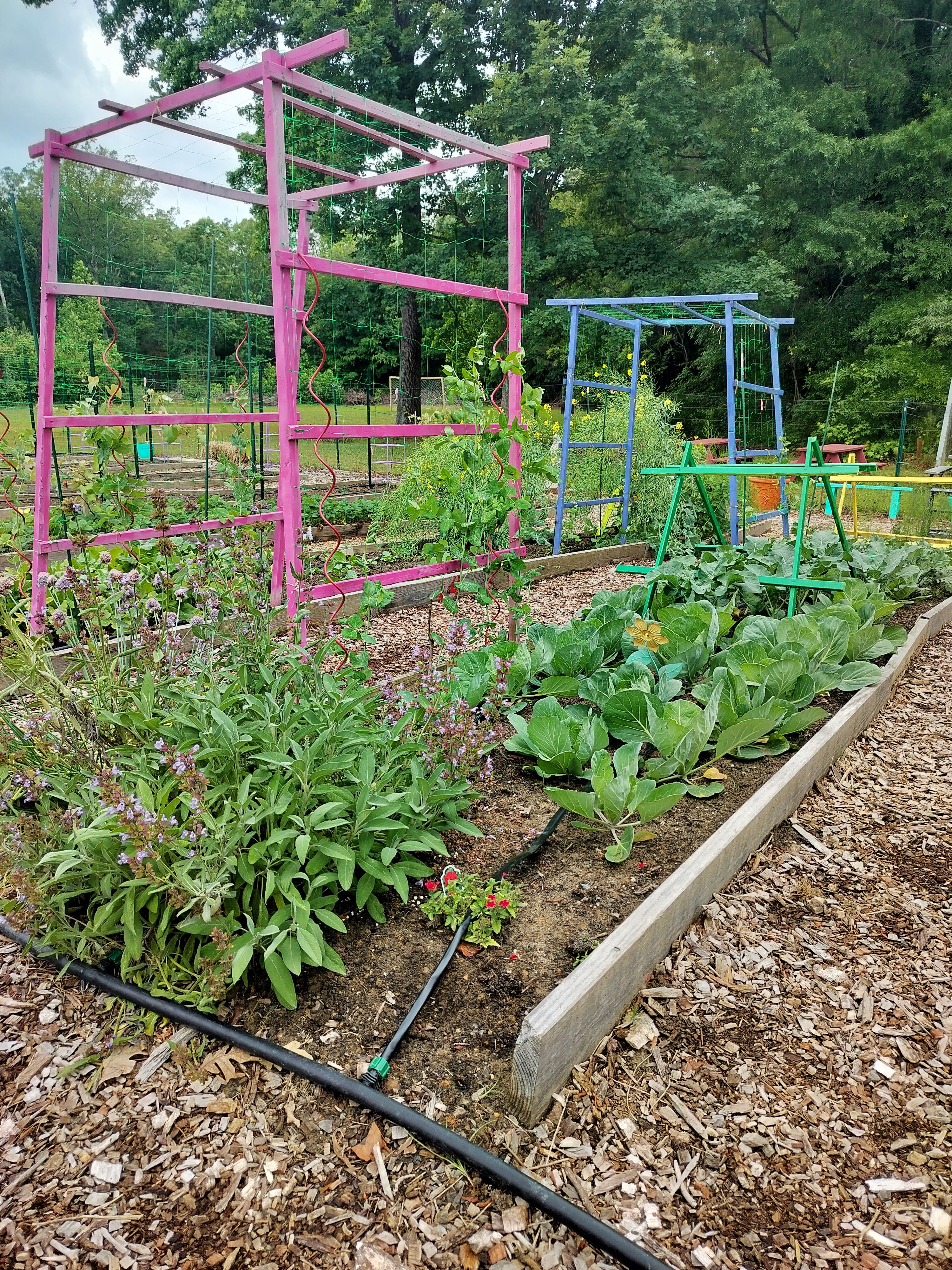
Our garden is currently around 900 square feet and includes seven long garden beds and a small melon patch. Four beds have vertical trellises that run the entire length of the bed. There are four arching trellises connecting other beds. There is a corner pollinator garden featuring native plants and a few other small sections with saint statues and seasonal flowering plants.
Garden Practices
Garden Practices
Our community garden is designed with environmental sustainability in mind. We practice organic gardening methods that eliminate synthetic chemicals, protect soil health, and support safe, nutrient-rich food production. To conserve water, we use drip irrigation systems that deliver moisture directly towards plant roots, reducing waste and runoff. We compost to transform garden and vegetable scraps into rich soil amendments. We promote the presence of pollinators in the garden.
Spring/Fall cool weather vegetables including kale, collards, broccoli, cabbage, turnips, radishes, and asparagus.
Summer warm weather vegetables including 3 types of tomatoes, 6 types of peppers, eggplants, carrots, cucumbers, walking onions, cantaloupe, sweet potatoes, butternut squash, and zucchini.
Herbs including parsley, oregano, sage, calendula, echinacea, citronella, and basil.
Native pollinator plants including Golden Rod, Milkweed, Coreopsis, Helianthus, Liatris, Yarrow, Bee Balm.
French Marigolds for pest deterrence.
Hundreds of pounds of produce are grown and donated to our food ministry that provides fresh, organic produce for the homeless and food insecure. A group of volunteers work together in faith and community all season to learn and grow through our garden ministry.
Additional Information
Additional Information
The garden experienced some fungal/blight issues, as well as a variety of pests. The fungal/blight issues took down all of our tomatoes and cucumbers early in 2025. We began educating volunteers on these challenges. We have installed more trellis structures for vertical growth that will allow for better air movement around plants. We utilize more organic pest and disease reduction methods. We had a mishap with a portion of our irrigation tubing and have since learned all about irrigation lines and emitters.
We rely on the skills of our amazing volunteers. Volunteers with carpentry, fencing, or paver skills are always needed. We are in need of a sturdy fence around the perimeter of our garden. We currently utilize netting. Funding is always needed for soil amendments, mulch, plants, expansion projects, etc.
We successfully expanded the original size of the garden, lengthening the garden beds. We installed a robust irrigation system The entrance was smoothed out and pavers put down. A couple of garden benches along with areas of prayer/reflection were added. Robust vertical trellis structures were installed. We became more organized and knowledgeable. We expanded our list of what we grow and added a native pollinator garden and a small melon patch.